
Short answer
Repair your sofa if the frame is sound, especially if it is solid wood. Sagging seats, flat cushions, torn fabric, creaks and loose legs can all be fixed for less than a comparable new sofa. Replace it if the frame is cracked particle board, termites have spread through it, or it no longer suits your room.
Key takeaways
- The frame decides everything. A sound solid-wood frame is almost always worth repairing.
- Sagging is usually foam or springs, not the frame, and both can be replaced.
- Compare a repair quote with a new sofa of the same build quality, not the cheapest one.
- Leatherette that peels cannot be patched invisibly; it needs re-covering.
A sofa rarely fails all at once. The seat starts to dip, a cushion goes flat, the fabric wears through on the arm, or a leg starts to wobble. At that point most people assume the sofa has had its day and start looking for a new one.
Often it hasn't. In a furniture workshop, the sofas that come in for repair are mostly sound frames wearing tired foam and fabric. The useful question is not "how old is it?" but "what exactly has failed, and what is it built on?" This guide walks through how to answer that yourself, before you spend money either way.
Check the frame before anything else
Everything you can see and feel on a sofa, the fabric, the cushions, the springs, is a replaceable layer fixed to a frame. If the frame is strong, every other part can be renewed and the sofa will sit like new. If the frame is broken and made of board, no amount of new fabric will save it.
So the decision comes down to two facts:
- What is the frame made of? Solid hardwood such as sheesham or teak, good plywood, or particle board.
- Is it still rigid? No cracks, no twisting, joints tight.
A sound solid-wood frame is almost always worth repairing. A cracked particle-board frame almost never is.
What is inside a sofa
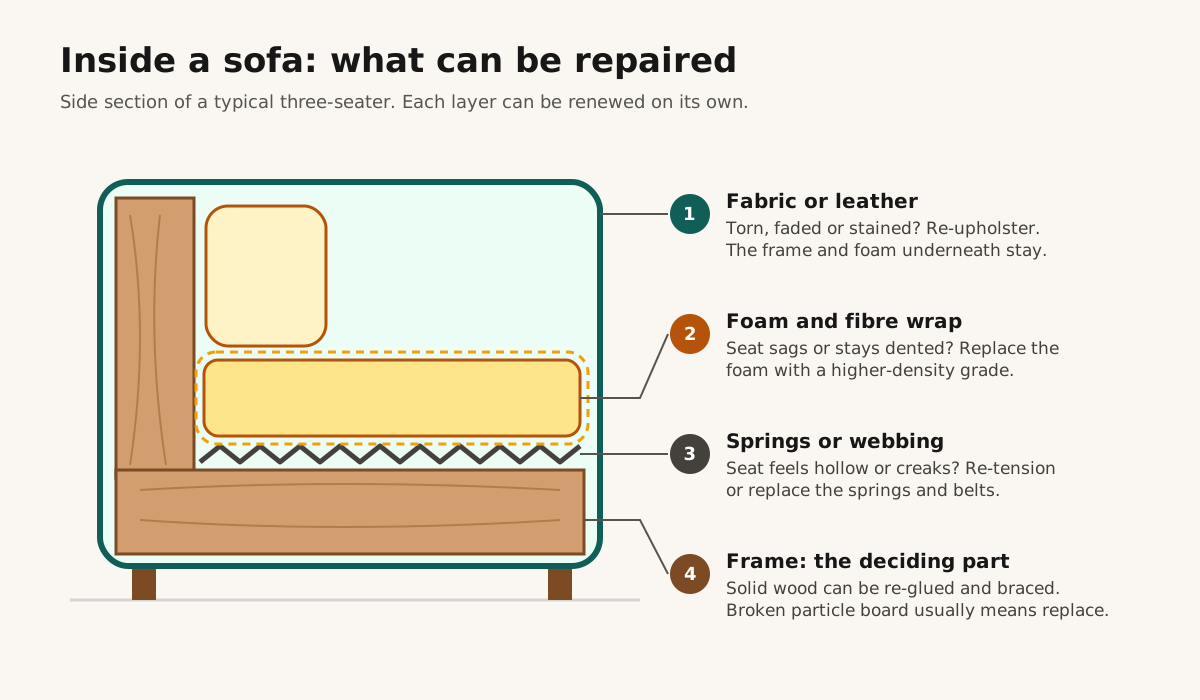
A typical upholstered sofa has four layers:
- Fabric or leather. The outer cover. It takes the most wear, especially on the front edge of the seat and the tops of the arms.
- Foam and fibre wrap. Polyurethane foam gives the seat its shape; a polyester fibre wrap softens the edges. Foam slowly loses its height and bounce with use.
- Suspension. Under the seat foam sits either zig-zag steel springs (also called sinuous springs) or stretched elastic webbing belts. This is what stops you sinking to the frame.
- Frame. The timber or board skeleton, joined with glue, dowels, screws and corner blocks.
Knowing these layers makes most problems easy to diagnose.
Signs your sofa can be repaired
These problems are common, and all of them are fixable:
- The seat dips or sags in the middle. Worn foam, stretched webbing or a sprung zig-zag clip. Replaceable.
- Cushions are flat and don't recover. The foam has lost its density. New foam is cut to size.
- You can feel the springs or a hard rail. The padding over the suspension has broken down.
- The fabric is torn, faded or stained. Re-upholstery replaces the cover completely.
- An arm or the back feels loose. Usually a joint whose glue has failed, which can be re-glued and braced.
- It creaks when you sit. Loose joints or a spring rubbing on the frame.
- A leg is wobbly or broken. Legs can be re-fixed or replaced.
Signs it is time to replace it
Repair stops making sense when:
- The frame is particle board and has cracked or crumbled at a joint. Board doesn't hold new screws well once it breaks.
- Termites or borers have spread through the frame. Small, local damage can be cut out and replaced in solid wood; damage throughout the frame cannot.
- It has been soaked by flood water or a leak. Foam and fibre that stayed wet can harbour mould. The frame may be saved, but everything else must go.
- It no longer fits your life. Too big for a new flat, wrong shape for the room, or not comfortable for you even when new. Repair restores a sofa; it doesn't change its size.
How to check your sofa's frame at home
You don't need tools for a first assessment. Five minutes is enough:
- Lift one front corner about 10 cm off the floor. On a rigid frame, the other front leg lifts too. If it stays on the floor while the frame flexes, the frame is twisting, which usually means a broken joint.
- Press down firmly on each arm and the top of the back. Movement or a cracking sound points to a failed joint.
- Turn the sofa on its back and look under the base. Most sofas have a thin black dust cover. At the corners you can often see whether the frame is timber with grain, plywood with layers, or particle board with a speckled, crumbly edge.
- Unzip a seat cushion if it has a zip. Squeeze the foam: if it crumbles, smells stale or has a hollow in the middle, it needs replacing regardless.
- Feel the weight. Solid-wood sofas are heavy. A three-seater you can lift easily on your own is probably built from board.
If the frame passes these checks, the sofa is a repair candidate.
Common sofa problems and their repairs
| Problem | Likely cause | Repair |
|---|---|---|
| Seat sags in the middle | Worn foam or stretched webbing | Re-web or re-spring, fit new seat foam |
| Cushions flat and lifeless | Foam has lost density | New foam cut to size, new fibre wrap |
| Arm or back wobbles | Glue joint failed | Open up, re-glue, add corner blocks |
| Creaking | Loose joint or spring clip | Tighten joints, re-fix springs |
| Fabric torn or worn through | Normal wear | Re-upholster the whole sofa, or one panel |
| Leatherette peeling | PU coating breaking down | Re-cover in new material |
| Broken leg | Impact or loose fixing | Re-fix or replace the legs |
Repair or new: a fair way to compare cost
Ask for a repair quote, then compare it with what a new sofa of the same build quality would cost: same frame material, same seat depth, same kind of foam. Comparing a repair on a solid sheesham frame with a cheap board sofa from a sale is comparing two different products.
As a rough rule, if a full repair costs well under half of a comparable new sofa, repair usually wins. Three things tip it further:
- The frame is already proven. A frame that has stood for ten years without breaking will very likely stand for ten more.
- It fits your room. Sofas are often bought to suit a particular wall or alcove, and finding a new one that fits as well is harder than it sounds.
- It matters to you. A sofa from your parents' home or your first flat carries value no new one has.
Re-upholstery: choosing fabric and foam
If you are re-upholstering, you are effectively specifying a new sofa on an old frame, so the choices are worth a few minutes.
Fabric. Tightly woven polyester and blended fabrics wear well and clean easily. Velvet looks rich but shows pressure marks. Cotton and linen feel cool in summer but stain more readily. For homes with children or pets, pick a darker or patterned fabric with a tight weave.
Leatherette and leather. PU leatherette (often called rexine) is affordable and wipes clean, but in a hot, dry city like Bhopal it can crack or peel within a few years, especially near a sunny window. Genuine leather costs more and lasts far longer if it is conditioned occasionally.
Foam. Seat foam should be firmer and denser than back foam, because it carries your full weight every day. Foam is graded by density (kilograms per cubic metre); ask what density is being used for the seat, and avoid the softest grades there. High-resilience (HR) foam keeps its bounce longer than standard foam.

How long does sofa repair take?
It depends on the job. Re-gluing a joint or replacing legs is quick. Replacing seat foam usually takes a few days. A full re-upholstery, where the sofa is stripped to the frame, takes longer, and the timing also depends on whether your chosen fabric is in stock. A repairer should give you a clear timeline with the quote.
Making a repaired sofa last
A few habits double the life of new foam and fabric:
- Rotate and flip loose cushions every few weeks so wear spreads evenly.
- Keep it out of direct afternoon sun. It fades fabric and dries out leather and leatherette.
- Vacuum regularly. Bhopal's summer dust is abrasive and works into the weave.
- Don't sit on the arms or the front edge. That concentrates weight on the parts that fail first.
- Leave a small gap from the wall so air can move behind it in the monsoon.
Sofa repair in Bhopal
If you're not sure which side of the line your sofa falls on, the simplest next step is to send a few photos: the whole sofa, the underside, and the problem area. That's usually enough to say whether it is a foam job, a frame job or a re-upholstery, and to give you an honest view on whether it is worth doing.
Paridhi Furniture repairs and re-upholsters sofas from its showroom and workshop in MP Nagar, Bhopal. See what is involved on our sofa repair page, or read about furniture repair and restoration for wooden pieces. If you decide new is the right call, our living room collection shows the sofas we make to measure.