
Short answer
Old furniture is usually worth restoring if it is solid wood, its frame and joints are basically sound, and insect damage is limited to small areas. Surface wear, loose joints, broken parts and tired polish are all repairable. It is rarely worth restoring particle-board furniture or pieces with termite damage running through the main structure.
Key takeaways
- Solid wood is the first test: it can be repaired and refinished many times.
- Loose joints, scratches, stains and faded polish are routine restoration work.
- Widespread termite damage or crumbling board usually means replace.
- Compare the cost with new furniture in the same timber, not with flat-pack.
Almost every family has one: the teak almirah that came from a grandparent's house, a carved diwan, a heavy sheesham dining table with a faded, sticky finish, a pair of chairs with loose legs. The question is always the same. Is it worth restoring, or is it time to let it go?
There is no sentimental formula, but there is a practical one. A few checks tell you whether a piece is a good restoration candidate, and knowing what the work involves helps you judge a quote. This guide covers both.
Five questions that decide it
- Is it solid wood? Solid timber can be repaired, sanded and refinished many times. Particle board and thin veneer over board cannot.
- Is the structure sound? Loose joints are routine to fix. A frame that is split, rotten or crumbling is a much bigger job.
- How far has insect damage spread? A few borer holes in a leg are a small repair. Termites through the whole frame are not.
- Does it suit your life? A restored piece still has the same size and shape. Make sure it fits the room and the way you live.
- Does it matter to you? Some pieces are worth restoring for what they mean, even when the arithmetic is close.
If the answers to the first three are yes, sound and limited, the piece is very likely worth restoring.
How to tell solid wood from veneer and board
Much older Indian furniture was made from solid teak, sheesham or other hardwoods, often from mature timber that is hard to buy today. Later furniture, especially from the 1990s onwards, often used veneered plywood or particle board. To find out what you have:
- Look at the end of a top or a shelf. Solid wood shows end grain, the growth rings, at the ends of boards. Plywood shows thin layers. Particle board shows compressed chips.
- Check inside drawers and the back panel. Unfinished inner surfaces reveal the real material.
- Look at the corners of drawers. Interlocking dovetail joints suggest traditional solid-wood construction.
- Feel the weight. Solid hardwood furniture is heavy.
- Follow the grain. On solid wood, the grain pattern on the top continues down the edge. On veneer, there is a visible line or edge band.
Veneered furniture can still be restored if the veneer is intact and thick enough, but it can only be sanded lightly, once or twice.
Damage that is easy to fix, and damage that is not
| Problem | Usually fixable? | What is involved |
|---|---|---|
| Faded, scratched or sticky polish | Yes | Clean, sand and refinish |
| White water rings and heat marks | Usually | Treat the finish, or refinish the surface |
| Loose or wobbly joints | Yes | Dismantle, clean out old glue, re-glue and clamp |
| Broken leg, rail or moulding | Yes | Make and fit a matching replacement part |
| Lifting or blistered veneer | Usually | Re-glue and press; patch small missing areas |
| Wood borer holes in one area | Yes | Treat, fill and refinish; replace badly tunnelled parts |
| Cracks in solid tops | Often | Glue and clamp, or fit a matching strip of timber |
| Termites through the main frame | Rarely worth it | Large sections need replacing |
| Swollen, crumbling particle board | No | Replace the panel or the piece |
What restoration actually involves
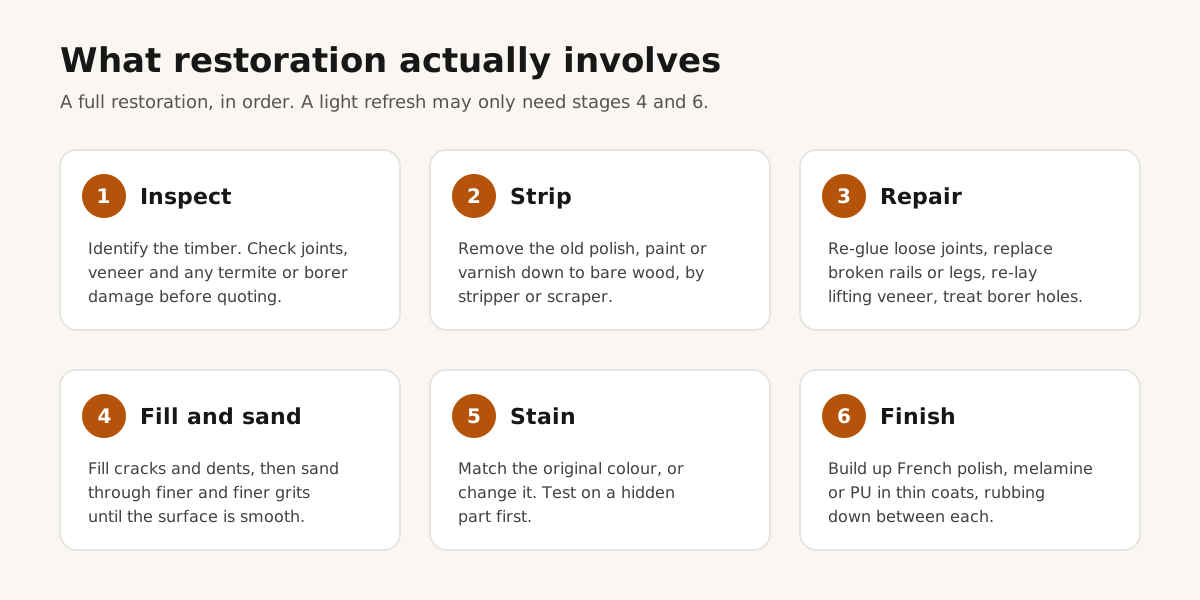
A full restoration usually follows six stages:
- Inspect. Identify the timber, check every joint, look for veneer damage and insect activity, and decide what needs replacing. This is what a good quote is based on.
- Strip. The old finish, which may be decades of polish, paint or varnish, is removed down to bare wood with chemical stripper or careful scraping.
- Repair. Loose joints are taken apart, cleaned and re-glued. Broken parts are replaced with matching timber. Lifting veneer is re-laid. Borer holes are treated.
- Fill and sand. Cracks, dents and holes are filled, and the surface is sanded through progressively finer grits until it is smooth.
- Stain. If needed, the wood is stained to match the original colour, to even out new and old timber, or to change the colour entirely. A test on a hidden part comes first.
- Finish. The new finish is built up in thin coats, with light sanding between each, until it has the depth and protection the piece needs.
Not every piece needs every stage. Furniture that is structurally sound with a tired finish may only need a clean, a light sanding and a fresh polish, which is quicker and costs less.
Choosing a finish
The finish decides how the restored piece looks and how well it stands up to daily use.
| Finish | Look | Durability | Best for |
|---|---|---|---|
| French polish (shellac) | Deep, warm, traditional shine | Low; marks with water and heat | Display pieces, antiques, carved work |
| Melamine | Clear, smooth, matt to gloss | Good | Most furniture: wardrobes, beds, cabinets |
| PU (polyurethane) | Matt, satin or high gloss | Very high; resists water, heat and scratches | Dining tables, coffee tables, hard-working surfaces |
| Lacquer (NC) | Smooth, quick-drying | Moderate | Furniture with light use |
| Duco or paint | Opaque colour, wood hidden | Good | Updating a piece with damaged or plain wood |
For an inherited teak or sheesham piece that will be used every day, PU or melamine usually gives the best balance of look and protection. French polish is beautiful and authentic, but it needs care: coasters, mats and no wet glasses.
Restore, refresh or repurpose?
Restoration isn't all or nothing:
- Refresh when the structure is fine and only the finish is worn. It is the quickest and least expensive option.
- Restore when joints, parts or veneer need work as well as the finish.
- Repurpose when a piece no longer fits its original role. Shelves can be fitted to an old almirah, a worn dressing table can become a console, and new upholstery on an old wooden sofa frame can update it completely.
If the piece is a sofa or chair with tired upholstery, the same logic applies to its frame. Our guide to repairing or replacing a sofa explains how to check it.
Restoration or new: comparing honestly
When you compare a restoration quote with buying new, compare it with new furniture in the same timber and quality. A new solid teak almirah is a very different purchase from a flat-pack wardrobe. Set against equivalent new solid-wood furniture, restoration usually compares well, and you keep a piece whose timber has already proven it can last for decades.
Factor in the things that don't appear on a quote: the piece fits the space it was bought for, it is already seasoned and stable, and it carries family history that no new piece can.
How long does restoration take?
A refresh of the finish on a sound piece can be done fairly quickly. A full restoration takes longer, because each stage needs time: glue must cure under clamps, filler must harden, and every coat of finish must dry before the next is applied. A large almirah or dining set with several repairs naturally takes longer than a single chair. A restorer should give you a timeline with the quote, and explain which stages take the time.
Caring for a restored piece
A new finish lasts far longer with a little care. Use coasters and mats on tables, especially with French polish. Keep pieces out of strong afternoon sun, which fades colour and dries out wood. Dust with a soft, dry cloth, and avoid household sprays containing silicone, which make any future repolishing harder. Leave a small gap behind large pieces so air can circulate in the monsoon, and look for fresh borer powder or termite mud tubes once a year.
Questions to ask a restorer
- What timber is it, and is it solid wood or veneer?
- Which joints and parts need work, and will replacement parts match the original timber?
- Is there any insect damage, and how will it be treated?
- Will the old finish be stripped completely, or refreshed?
- Which finish do you recommend for how I will use it, and how should I care for it?
- How long will it take, and can I see the piece before the final coat?
Furniture restoration in Bhopal
The best first step is to share a few clear photos: the whole piece, the problem areas, and the inside of a drawer or the back panel. That is usually enough to tell whether it is solid wood, what the work involves, and whether restoration makes sense.
Paridhi Furniture repairs and restores wooden furniture in its MP Nagar workshop in Bhopal. See what is involved on our furniture repair and restoration page, or read our monsoon care guide to keep a restored piece in good condition.