
Short answer
Choose a sliding wardrobe if there is less than about 90 cm between the wardrobe and the bed, because sliding doors need no swing space. Choose hinged doors if you have the room: they cost less, show the whole interior at once, fit corners and are easier to maintain. In most bedrooms the clearance decides it.
Key takeaways
- Measure the gap between the wardrobe front and the bed before choosing a door type.
- Hinged doors need roughly 90 cm clear; sliding doors work with about 60 cm.
- Sliding wardrobes are a little deeper and only open halfway at a time.
- Hinged doors are usually cheaper and simpler; sliding systems depend on good hardware.
A wardrobe is one of the largest things in a bedroom, and the doors you choose change how the whole room works. Hinged doors swing open into the room; sliding doors glide across each other on tracks. Each has a real advantage, and the right choice is usually decided by one measurement: the distance between the wardrobe and whatever stands in front of it.
This guide explains how much space each type needs, what you gain and give up with each, and how to choose for your room.
The quick answer, by room
- Small bedroom, bed close to the wardrobe: sliding.
- Bedroom with at least 90 cm clear in front of the wardrobe: hinged is usually the better value.
- Wardrobe running into a corner: hinged, because sliding doors cannot turn a corner.
- Children's room: hinged, with soft-close hinges; simpler and sturdier for small hands.
- You want a full-length mirror on the doors: sliding doors carry large mirrors well.
- Wide wall, minimal look: sliding doors give long, uninterrupted panels.
How much floor space each type needs
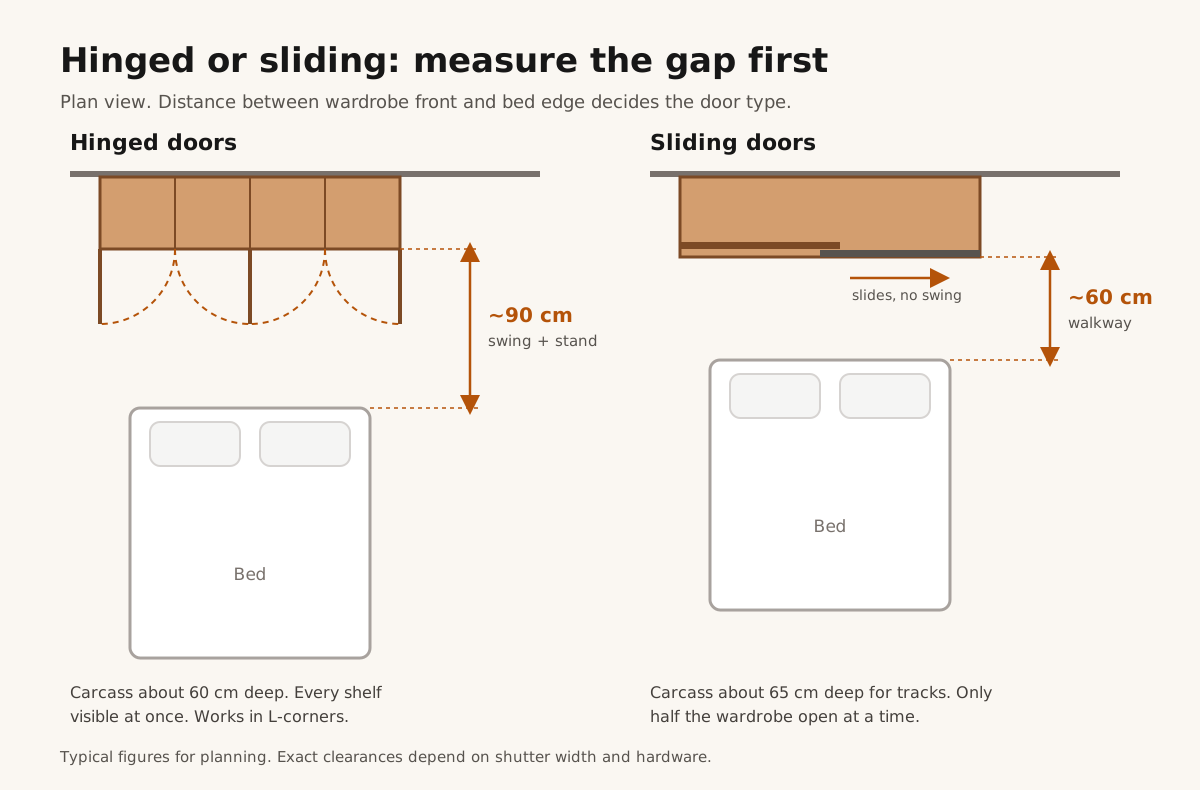
A hinged door swings out by its own width. Wardrobe shutters are usually 45 to 60 cm wide, so that is the arc each door sweeps. You also need to stand in front of the open door to reach inside. Together that means you should allow roughly 90 cm (about 3 feet) clear between the wardrobe and the bed, desk or opposite wall.
A sliding door doesn't swing at all. You only need enough space to walk and stand in front of the wardrobe, so about 60 cm is workable.
So the first step is to measure. In many Indian apartments, a queen or king bed leaves only 60 to 75 cm between its side and the wardrobe wall, and in that situation sliding doors are not a style choice; they are the only kind that will open properly.
Hinged wardrobes: pros and cons
Advantages
- Full access. Open all the doors and you can see and reach the entire interior at once.
- Lower cost. Hinges are far cheaper than a sliding track system, and the doors are simpler to make.
- Flexible interiors. Shelves, hanging rails and drawers can go anywhere, because no door overlaps another section.
- Corners and odd spaces. Hinged doors work on L-shaped wardrobes, in alcoves and under sloping ceilings.
- Easy maintenance. A sagging door is fixed by adjusting the hinge with a screwdriver.
- Slimmer. A standard depth of about 60 cm is enough.
Disadvantages
- Needs swing space in front, as above.
- Doors left open get in the way, and can be knocked into in a tight room.
- More visible joins between shutters on a wide wall.
Sliding wardrobes: pros and cons
Advantages
- Saves floor space. Nothing swings into the room, so the wardrobe can sit close to the bed.
- Clean look. Large panels with few joins suit modern interiors and wide walls.
- Great for mirrors. A full-length mirror on a sliding door makes a small room feel larger.
- Doors never left open in the way.
Disadvantages
- Only half open at a time. With two doors, you can see only half the wardrobe at once; with three, about two-thirds.
- Deeper. The tracks need space at the front, so the carcass is usually about 65 cm deep.
- Interior constraints. Drawers must sit where a door can slide fully clear of them.
- Costs more. Good sliding hardware is a significant part of the price.
- Hardware dependent. Cheap rollers and tracks are the most common cause of wardrobe complaints.
- No corners. Sliding doors need a straight run.
Hinged vs sliding: side by side
| Factor | Hinged | Sliding |
|---|---|---|
| Clearance needed in front | About 90 cm | About 60 cm |
| Carcass depth | About 60 cm | About 65 cm |
| Access | Whole interior at once | Half or two-thirds at a time |
| Typical cost | Lower | Higher, mainly hardware |
| Corner and L-shaped units | Yes | No |
| Large mirrors | Possible, but heavy on hinges | Well suited |
| Maintenance | Adjust hinges occasionally | Clean tracks, adjust rollers |
| Best for | Medium to large rooms, corners, budgets | Small rooms, wide walls, modern look |
How to measure your room before you order
Five measurements tell a maker almost everything about the wardrobe your room can take:
- Wall width where the wardrobe will stand, at floor level and at ceiling level. Walls are rarely perfectly straight.
- Floor-to-ceiling height, measured in two or three places along the wall, so a loft can fit tight to the ceiling.
- Clearance in front: the distance from the wall to the nearest obstacle, whether that is the bed, a bedside table, a door or a window.
- Door and window positions, including which way the room door swings and the height of any window sill on that wall.
- Switches, sockets and AC lines on the wall, which the wardrobe must either avoid or work around.
Note any skirting, beams or pillars too. A sliding wardrobe in particular needs a level floor and ceiling for its tracks; a made-to-measure unit can be scribed to suit walls that are out of true.
What about open or walk-in wardrobes?
If you have a spare room or a deep alcove, a walk-in wardrobe with no doors at all avoids the hinged-or-sliding question entirely. It gives the easiest access of any option, but clothes are exposed to dust, which is a real consideration in a dry Bhopal summer. Many people combine the two: open hanging for everyday clothes, with closed drawers and hinged cabinets for everything else. A semi-open design, with glass-fronted or fabric-screened sections, is another middle way.
Planning the inside
Whichever doors you choose, the interior decides how useful the wardrobe is day to day:
- Long hanging for dresses, sarees on hangers and coats needs about 150 to 160 cm of height.
- Short hanging for shirts and folded trousers needs about 90 to 100 cm; two rails, one above the other, double the capacity.
- Shelves for folded clothes are most useful 30 to 40 cm apart. Deeper shelves just stack clothes into piles you can't reach.
- Drawers for innerwear and accessories, ideally at waist height so you don't need to bend.
- A loft above, up to the ceiling, for suitcases, quilts and seasonal clothes.
- A locker or safe compartment, if you want one, planned in from the start.
For a sliding wardrobe, plan the interior around the door positions, so that drawers and frequently used shelves are not hidden behind a door that will always be in the way.
Materials and finishes
Use BWR plywood for the carcass, with the shutters in plywood, HDHMR or a framed panel, depending on the finish. Sliding doors in particular must be flat and stable, because a slight warp is enough to make them rub. Laminate is the most durable and economical finish; acrylic and lacquered glass give a high-gloss look; mirrors suit sliding doors. If you want the warmth of real wood, a veneer finish gives you the grain without the movement of solid timber in wide panels. Our guide to teak, sheesham and plywood explains the plywood grades.
Looking after a wardrobe in Bhopal's climate
- Clean sliding tracks every few weeks. Summer dust builds up quickly and makes doors drag.
- Keep the wardrobe off outer walls, or leave a small gap behind it, so it doesn't take up damp in the monsoon.
- Use moisture absorbers inside during the rains, and air the wardrobe on dry days.
- Adjust hinges when a door starts to sag or catch; it takes a minute with a screwdriver.
Our monsoon furniture care guide covers damp and termites in more detail.
Common mistakes to avoid
- Choosing sliding doors for looks in a room that has space for hinged ones, then losing half the access every day.
- Forgetting the bedside tables. Measure clearance from the nearest obstacle, not from the bed.
- Cheap sliding hardware. It is the part that fails first.
- Too few drawers and too much shelf space. Deep shelves become piles; drawers stay organised.
- No loft. The space above a wardrobe is the easiest storage in a bedroom.
Wardrobes made to measure in Bhopal
A made-to-measure wardrobe can use the full wall, the full height and the door type your room actually needs. Paridhi Furniture designs and builds wardrobes in its MP Nagar workshop in Bhopal. See designs in our wardrobe and storage collection and bedroom collection, or book an interior consultation to plan the whole room.